
Food labels aren’t marketing decorations; they’re the end-product of a disciplined food-safety system. Behind every line of text sits a trail of supplier vetting, laboratory tests, risk assessments, and legal checks that aim to keep you safe and informed. This article explains, in plain English, how professionals create labels, what “specifications” and “Certificates of Analysis (CoA)” actually are, how companies make sure food is safe to eat, and how you should read allergen statements—including “may contain”—to protect yourself and your family. Wherever possible, I cite primary, authoritative sources and the latest 2025 updates.
1) How a label is created inside a food company
A compliant label begins with a product specification. Think of the spec as the product’s contract: it captures the recipe and ingredient names as they must legally appear, the allergens to emphasise, the nutrition values, the pack sizes, storage and date-marking instructions, country-of-origin claims (if any), and all mandatory statements for the target market (e.g., UK/EU “FIC” rules). In the UK and EU, the governing law is Regulation (EU) No 1169/2011 on the provision of food information to consumers—retained in UK law—covering ingredient lists in descending weight, mandatory allergen emphasis in the ingredients list, nutrition information, business name/address, lot code, and origin where required.
Those specifications are fed into a label approval workflow, often inside a PLM/ERP artwork system, where the artwork is proof-read and signed off by technical, legal, and marketing. Modern retailer and certification standards, such as BRCGS Food Safety Issue 9, require documented controls to ensure that label text always matches the live specification and that artwork is re-reviewed whenever recipes, suppliers, origins, regulations, or claims change. Auditors check for this change-control discipline, traceability, and that allergens are correctly declared and emphasised.
Before anything is printed, the business must be confident the ingredients themselves are what suppliers claim. That starts with supplier approval and raw-material specifications for every input (including packaging). BRCGS Issue 9 expects risk-based supplier verification, raw-material acceptance criteria, and the ability to trace lots through production within hours—because fast, accurate traceback underpins effective recalls if something goes wrong.
Laboratory evidence ties it all together. A supplier (or an accredited lab) issues a Certificate of Analysis (CoA) for each lot of a raw material or finished product. A CoA records the test methods and results against the agreed specification—for example, microbiology, moisture, fat, salt, allergen residue swabs, or vitamin levels—so the site can prove each batch meets its limits. In short, the spec defines the targets; the CoA shows a specific batch hit them.
All of this sits on top of Codex HACCP, the globally recognised system for identifying biological, chemical (including allergens), and physical hazards, then controlling them through Preventive Controls, Critical Control Points, and verification. The 2020 revision of Codex CXC 1-1969 emphasises Good Hygiene Practices and risk-based controls; most retailer and regulatory systems align to this backbone.

2) How companies make sure food is safe to eat
Safety is managed through layered controls. HACCP and Good Hygiene Practices define where hazards can arise and how to prevent or reduce them to safe levels (for example, validated cook steps for pathogens, segregated allergen handling, label checks at packing). Internal verification includes routine micro testing, cleaning validation, allergen-swab results, metal detection or X-ray records, and line-clearance checks between products. External verification includes CoAs from accredited labs, regulatory inspections, and independent certification audits against standards such as BRCGS. If anything changes—new supplier, reformulation, new packaging line—the label and risk assessments are re-reviewed so the on-pack information stays correct.
For the label content itself, the law is prescriptive. In the UK/EU, allergens must be emphasised in the ingredients list (e.g., bold) and non-prepacked foods must still provide allergen information; in the UK, “Natasha’s Law” further requires full ingredients plus emphasised allergens on PPDS (prepacked for direct sale) items. In practice, bakers, delis, cafés, and takeaways use approved recipes and ingredient decks generated from their specs so the PPDS label matches what’s in the food.
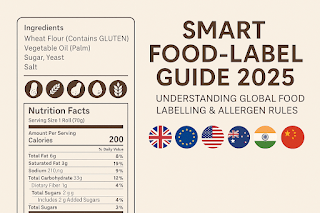
This is a product specification created for reference — showing how a professional food specification looks and what information lies behind every packaged product. This artwork is prepared and verified by a qualified Food Scientist to demonstrate how food safety, quality, and compliance are ensured before a product reaches consumers.

3) What “may contain” actually means—and how to use it
You’ll often see a Precautionary Allergen Labelling (PAL) statement like “may contain nuts.” PAL does not mean the ingredient is intentionally present; it indicates a residual risk of cross-contact that remains even after good controls, based on a documented risk assessment. UK Food Standards Agency guidance stresses PAL should be specific (e.g., “may contain peanuts”) and used only when an unavoidable risk remains; blanket or catch-all PAL can mislead and reduce choice for allergic consumers. Health authorities in other countries take a similar stance. If a business can reduce the risk to a negligible level through segregation and validated cleaning, PAL should not be used.
If you have a diagnosed food allergy or coeliac disease, treat PAL as a real risk signal. Choose products with clear ingredient/allergen lists and, where relevant, certified “free-from/gluten-free” claims that are supported by the law and by robust controls. When in doubt, contact the brand’s consumer care line for batch-specific information. In the UK eating-out context, always ask for written allergen information before ordering and confirm again on delivery.
4) Allergens you’ll see on labels—by country/region, and what reactions look like

United Kingdom & European Union. Labels must highlight the 14 regulated allergens in Annex II of the FIC rules: gluten-containing cereals, crustaceans, eggs, fish, peanuts, soybeans, milk, tree nuts, celery, mustard, sesame, sulphur dioxide/sulphites (≥10 mg/kg or L), lupin, and molluscs. These must be emphasised within the ingredients list; non-prepacked foods must also provide allergen information.
United States. The FASTER Act added sesame as the ninth major allergen from Jan 1, 2023, so U.S. “Big 9” now includes milk, egg, fish, crustacean shellfish, tree nuts, peanuts, wheat, soy, and sesame. Sesame appears in the ingredients or in a separate “Contains” statement.
Australia & New Zealand. From 25 Feb 2024, PEAL formatting requires plain-English naming, bold emphasis in the ingredients list, and a “Contains: …” summary statement adjacent to it; tree nuts and relevant cereals must be named individually. Legacy stock runs down until 25 Feb 2026.
Canada. Priority allergens must be declared in the ingredients list or in an immediate “Contains” statement. Ingredients appear in decreasing order of proportion; enforcement is active for undeclared allergens and gluten.
India. Under FSSAI Labelling & Display Regulations, allergen declarations must be made for categories such as gluten-containing cereals (named), crustaceans, eggs, fish, peanuts/tree nuts, soybeans, milk, and sulphites ≥10 mg/kg; India-specific elements include the veg/non-veg logo and FSSAI license details.
China. The new GB 7718-2025 (released Mar 27, 2025) overhauls food-labelling rules and marks a step-change toward mandatory allergen labelling with clearer formatting. There is a two-year transition; enforcement begins Mar 16, 2027. If you export to China, plan label reprints and ingredient translations now.
What reactions look like. Food-allergy symptoms can include tingling in the mouth, hives/itchy rash, swelling of lips/face/eyes, wheeze or shortness of breath, tummy pain, vomiting or diarrhoea; anaphylaxis is the severe, life-threatening form, with airway swelling, breathing difficulty, collapse, or loss of consciousness—use your prescribed adrenaline auto-injector and call emergency services. National health services provide clear symptom checklists and action plans; follow your clinician’s advice.
5) Nutrition on the label and why it matters to your body
Reading the panel lets you manage salt, sugars, and fibre. High sodium intake raises blood pressure and cardiovascular risk; the WHO recommends adults keep sodium under 2,000 mg/day (about 5 g salt). If you’re comparing products, compare the per 100 g numbers. Added or free sugars contribute to weight gain and dental caries; WHO recommends <10% of energy from free sugars, with <5% offering extra benefit. On U.S. labels, “Added Sugars” is displayed explicitly to support this. Aim higher for fibre, which benefits gut and cardiometabolic health.
6) If you have a food allergy: how to stay safe every day
Treat the ingredients list as the single source of truth for intended ingredients, then check for PAL/“may contain” to understand residual risk. If the product is PPDS (e.g., packed on site in a café in England), look for full ingredients with bold allergens as required by Natasha’s Law. When dining out, ask for written allergen information before you order and confirm again when your food arrives. Carry your adrenaline auto-injector if prescribed, teach friends and carers how to use it, and wear a medical alert if advised. If you’re buying plant-based products, remember “vegan” is an ethical/recipe label, not an allergen guarantee; check for PAL and “free-from” claims supported by controls.
7) Behind the scenes: the methods professionals use to keep labels and food honest
The methods are systematic. A HACCP study identifies where hazards (including allergens) can enter and sets controls. Supplier approval and raw-material specs define exactly what’s acceptable on delivery. CoAs and in-house or third-party lab tests confirm each lot meets limits. Change control locks label text to the current spec, and artwork approval ensures every new or revised label is reviewed by technical and regulatory staff before print. Traceability tests prove the site can follow ingredient lots through to finished goods within hours, so a targeted recall is possible. Audits—both announced and unannounced—check that what’s on paper matches reality on the factory floor. All of these expectations are embedded in modern standards such as BRCGS Food Safety Issue 9 and the Codex General Principles of Food Hygiene, which most regulators and buyers recognise.
8) Key takeaways you can trust
Food labels are legal documents backed by risk assessment, testing, and audits—not just marketing. If you live with allergy or coeliac disease, your safest routine is to read the ingredients list every time, look for bold allergens (or “Contains” statements), and treat “may contain” as a genuine residual risk that should be there only when a risk assessment shows unavoidable cross-contact. The rules differ slightly by region—14 allergens in UK/EU, 9 in the U.S., PEAL formatting in Australia–NZ, clear priority allergen rules in Canada, FSSAI allergen declarations in India, and a new GB 7718-2025 regime in China—but the goal everywhere is the same: clear, consistent information that helps you make safe choices. Keep an eye on nutrition too: less sodium and free/added sugar, more fibre, and always compare by 100 g/100 mL for fair brand-to-brand decisions.
Sources & further reading (authorities and primary standards)
- EU/UK food information law: Regulation (EU) No 1169/2011 and official EU summary pages; UK retains and applies these rules.
- UK PPDS (Natasha’s Law) & PAL guidance: Food Standards Agency business guidance and PPDS explainer; technical guidance updated following 2023 consultation.
- United States allergens: FDA—FASTER Act makes sesame the 9th major allergen from Jan 1, 2023; FDA food-allergy hub.
- Australia–NZ: FSANZ allergen pages—PEAL requirements from Feb 25, 2024, with transition to Feb 25, 2026.
- Canada: Health Canada/CFIA—priority allergens, ingredient order, enforcement updates.
- India: FSSAI Labelling & Display Regulations compendium; allergen declaration clauses.
- China: USDA GAIN report on GB 7718-2025—effective Mar 16, 2027 after two-year transition; NHC Q&A (2025) notes implementation details.
- HACCP backbone: Codex General Principles of Food Hygiene (CXC 1-1969, rev. 2020).
- BRCGS Food Safety Issue 9: interpretation guidance; traceability and label-control expectations.
- Health guidance on reactions: NHS pages on food allergy and anaphylaxis—symptoms and what to do.
- Nutrition thresholds: WHO guidance on sodium (<2,000 mg/day) and free sugars (<10% energy; <5% for additional benefit).