
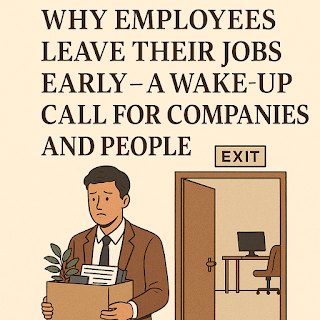
In today’s fast-moving professional world, it has become surprisingly common to see employees leaving their jobs within a few months of joining. Some don’t even complete their probation period. This isn’t limited to one industry — it’s happening in offices, food production units, startups, logistics companies, and even large corporate organisations.
The question that keeps coming up is simple but powerful: why do employees leave their jobs so early? Is it the company’s fault, the employee’s mindset, or something deeper in the modern work culture?
The truth is, it’s often a mix of all three.

The Expectation vs. Reality Gap
One of the most common reasons behind early resignations is the gap between what employees expect and what they actually experience. During interviews, job roles are often presented attractively — promises of career growth, supportive management, and a positive work environment. But once the employee joins, the reality may be very different.
This mismatch creates instant disappointment. The excitement that came with the new role quickly turns into frustration. Employees start wondering whether they made a mistake.
For companies, the solution begins with transparency. Honest communication during recruitment helps build trust and long-term relationships. And for employees, it’s equally important to research the company culture, talk to current employees if possible, and understand the job description thoroughly before accepting an offer.
The Leadership Problem
There’s an old saying — people don’t leave jobs, they leave managers. It still holds true today. A poor manager can make even a great job feel unbearable. Lack of appreciation, unclear instructions, micromanagement, or an unsupportive attitude can crush motivation faster than any workload.
Leadership isn’t just about giving orders; it’s about guiding, listening, and recognizing effort. When managers fail to connect with their teams, employees start to feel invisible. They lose their sense of purpose and begin looking for new opportunities.
Companies must invest in training their leaders — not only in technical skills but in emotional intelligence and communication. A good leader can retain talent even in challenging conditions. And for employees, before deciding to quit, it’s worth having an open conversation with the manager. Sometimes, honest feedback can lead to meaningful change.
No Growth, No Retention
Today’s professionals, especially young people, want more than stability — they want growth. If employees don’t see a clear path for learning or promotion, they start losing interest. It’s not always about money; it’s about progress, recognition, and a sense that they’re moving forward.
When employees feel stuck, they disengage. Productivity drops, and resignation becomes the next logical step.
Companies can prevent this by creating visible growth paths, offering mentorship, and rewarding development efforts. At the same time, employees should take responsibility for their own learning — ask for feedback, volunteer for new projects, and make themselves indispensable.
Toxic Work Culture
Even the best salary cannot make up for a toxic workplace. Gossip, office politics, bullying, lack of fairness, or favoritism can quickly destroy morale. When people feel anxious, disrespected, or constantly compared to others, they naturally start looking for an exit.
A company’s culture is not built on slogans written on walls — it’s built on the way people treat each other every day. Respect, inclusion, and appreciation are what keep employees loyal and motivated.
For employees facing toxicity, it’s important to protect their mental health. Leaving a toxic environment is not a sign of weakness; it’s an act of self-respect.
Work-Life Balance and Fair Compensation
Another leading reason employees leave early is poor work-life balance. Many companies still expect long hours without proper compensation or flexibility. Over time, this leads to burnout and resentment.
Employees today value time and flexibility as much as they value money. A rigid schedule, unrealistic targets, or constant overtime can push even the most dedicated person away.
Companies should realise that a well-rested, balanced employee performs far better than an overworked one. Offering fair pay, flexible hours, and wellness support creates a loyal and productive workforce. For employees, it’s equally important to evaluate their worth and ensure their efforts align with fair compensation.
The Search for Purpose
In the post-pandemic world, people are rethinking what work means to them. Many want to feel connected to their job’s purpose — they want to know that what they do matters. When a company’s values don’t align with an employee’s beliefs, that emotional connection breaks down.
Employees no longer stay in roles that only offer a paycheck; they want meaning, growth, and belonging. For companies, this means communicating their mission clearly and giving employees a sense of contribution. And for employees, it’s about finding a workplace whose values reflect their own.
The Burnout Factor
Burnout is one of the silent killers of modern careers. Constant pressure, deadlines, and lack of rest can drain both physical and emotional energy. When employees feel like they’re running a race with no finish line, they eventually give up.
Ignoring mental health leads to higher turnover and lower morale. Companies need to prioritise wellness programs, flexible schedules, and mental health awareness. A small effort toward employee well-being can create a massive difference in loyalty and performance.
Employees, too, should learn to recognise the signs of burnout — chronic fatigue, irritability, or loss of focus — and seek help early.
A Two-Way Mirror
When an employee leaves a job early, it reflects both sides of the story. It’s not always about a bad company or a difficult employee — sometimes it’s about miscommunication, poor alignment, or changing expectations.
Companies must look deeper into exit reasons, not just replace people quickly. Every resignation is a message — a signal of something that can be improved. Similarly, employees should think before quitting impulsively, ensuring that their next step is well-planned and purposeful.
The real goal is balance — a healthy relationship between the employer and employee, built on trust, clarity, and mutual respect.
Early resignations are costly, not only in terms of training and recruitment but also in morale and culture. A workplace that sees high turnover needs to stop and ask why people are leaving instead of blaming them for it.
On the other hand, employees should understand that consistency builds credibility. Leaving too often without reflection can make it harder to grow professionally.
The key lies in partnership. When companies treat employees as people — not just resources — and when employees approach jobs with honesty and patience, the workplace becomes a space for growth, learning, and long-term satisfaction.
After all, a job should never just be a place to earn. It should be a place to learn, grow, and belong.
About the Author
Written by Vipin Sharma — Food Technologist, wellness advocate, and blogger based in London. Passionate about promoting healthy workplace culture, mental well-being, and professional growth through his platform, Zenith Wellness Journal.