
Search interest around “pneumonic plague Russia 2026” has surged following reports involving a laboratory worker in Siberia, although a confirmed plague outbreak has not been established.
Updated: 5 October 2026
Reports surrounding the death of a laboratory worker at an anti-plague research institute in Siberia have suddenly pushed pneumonic plague back into international headlines.
The words “plague” and “Russia” understandably sound alarming. The disease is associated with some of the deadliest epidemics in human history, and pneumonic plague is its most serious respiratory form.
But there is an important fact to understand before going any further:

A pneumonic plague outbreak in Russia has not been confirmed.
Russian authorities say a worker at the Irkutsk Anti-Plague Research Institute developed pneumonia of unknown origin and later died. Precautionary measures were introduced, contacts were monitored, and parts of healthcare facilities were restricted. However, Russian officials said testing had not identified microorganisms associated with the woman’s professional work, and no confirmed secondary plague cases had been reported at the time of publication.
Reuters and AP both reported on 5 October that the cause of the woman’s pneumonia remained unconfirmed.
That distinction matters.
This article explains what is actually known about the Russia situation, what pneumonic plague is, how Yersinia pestis spreads, the symptoms doctors look for, how the infection is treated, what scientific research tells us and whether there is currently evidence of a wider global threat.
What Happened in Russia?
A woman working at the Irkutsk Anti-Plague Research Institute of Siberia and the Far East became seriously ill and later died after developing pneumonia.
Because she worked at an institute that handles dangerous infectious diseases, reports quickly appeared suggesting that she may have contracted pneumonic plague.
Some reports also claimed there had been a laboratory accident involving plague bacteria.
However, those claims have not been confirmed.
Russia’s public-health agency, Rospotrebnadzor, said that no accident involving pathogenic microorganisms had been identified at the institute.
Officials described the woman’s illness as “pneumonia of unknown etiology”, meaning that the exact cause had not yet been established publicly.
People who had been in contact with her were identified and placed under medical observation as a precaution. According to Russian regional authorities, those contacts had not developed symptoms attributable to the suspected event and initial laboratory testing was negative.
Reuters reported that authorities said there was no evidence linking the woman’s death to her work at the institute.
AP similarly reported that expanded testing had not identified microorganisms connected with her professional activities.
US health and government agencies are monitoring the situation and have asked for transparent information, but this should not be confused with confirmation of a plague outbreak.
What is confirmed?
A laboratory employee died after developing serious pneumonia.
Public-health precautions and contact monitoring were introduced.
International authorities are watching the situation.
What is not confirmed?
It has not been publicly established that she had pneumonic plague.
A laboratory release of Yersinia pestis has not been confirmed.
There is currently no confirmed chain of person-to-person plague transmission arising from this incident.
For a rapidly developing story such as this one, those distinctions are essential.
What Is Pneumonic Plague?
Plague is a bacterial infection caused by Yersinia pestis.
The bacterium is naturally maintained in populations of wild mammals — particularly rodents — and the fleas that live on them.
According to the World Health Organization (WHO), plague remains endemic in several parts of the world. During 2019–2025, most cases reported to WHO occurred in the Democratic Republic of the Congo and Madagascar.
Three major clinical forms of plague are generally recognised:
Bubonic plague
This is the most common form.
It is often acquired through the bite of an infected flea.
The bacteria travel to nearby lymph nodes, which can become severely swollen and painful. These enlarged lymph nodes are known as buboes.
Septicaemic plague
This occurs when Y. pestis multiplies in the bloodstream.
It can occur on its own or develop as a complication of another form of plague.
Severe cases can cause shock, bleeding, organ failure and tissue damage.
Pneumonic plague
Pneumonic plague occurs when the bacteria infect the lungs.
It may develop when plague infection elsewhere in the body spreads to the lungs, or it can develop after someone directly inhales infectious respiratory particles.
Pneumonic plague is particularly important from a public-health perspective because it is the form capable of spreading directly between people through infectious respiratory droplets or particles during close exposure.
WHO describes it as the most virulent form of plague.
What Are the Symptoms of Pneumonic Plague?
Symptoms can develop rapidly.
CDC guidance lists symptoms including:
- sudden fever
- headache
- weakness
- rapidly developing pneumonia
- shortness of breath
- chest pain
- cough
- sometimes bloody or watery mucus
The incubation period following respiratory exposure may be very short.
CDC guidance published in 2026 states that the incubation period for pneumonic plague is typically around one to three days, although a wider range of approximately one to six days can occur.
WHO notes that symptoms can occasionally begin within about 24 hours.
The early symptoms can resemble other serious respiratory infections.
That is why exposure history matters.
A doctor would consider factors such as recent presence in an area where plague is circulating, exposure to infected animals or fleas, laboratory exposure, or close contact with a person known or strongly suspected to have pneumonic plague.
How Does Pneumonic Plague Spread?
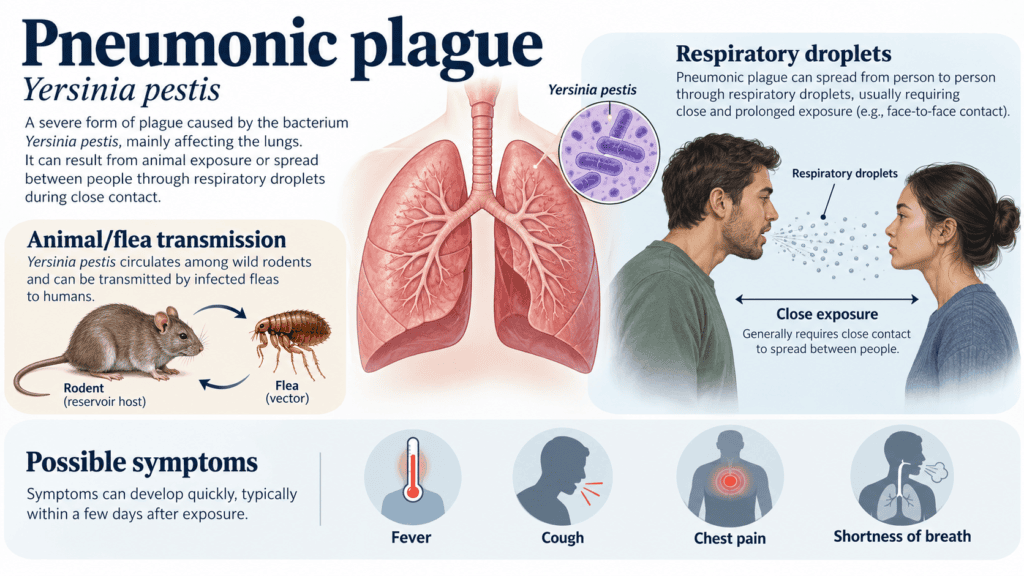
There is considerable misinformation online about this.
Plague can reach humans through several routes.
These include:
Infected flea bites. Fleas that have fed on infected animals can transmit Y. pestis when they bite humans.
Contact with infected animals or tissue. Handling infected animals or biological material without adequate protection can create a route of infection.
Respiratory transmission. Someone with pneumonic plague can expel bacteria-containing respiratory droplets when coughing.
However, pneumonic plague should not automatically be imagined as spreading in exactly the same way as highly transmissible respiratory viruses.
CDC states that person-to-person plague transmission is rare and typically requires direct, close exposure to a person with pneumonic plague who is coughing.
Its 2026 guidance defines a close-contact scenario as being within approximately six feet of a coughing pneumonic-plague patient.
CDC infection-control guidance also says pneumonic plague is not as contagious as is sometimes assumed, with transmission generally associated with close contact, particularly when severely ill patients are producing infectious sputum.
That makes plague biologically very different from diseases capable of sustained widespread transmission through populations before many infected people realise they are ill.
Can Bubonic Plague Spread From Person to Person?
Ordinary bubonic plague does not normally spread directly from one person to another.
The concern arises when the infection reaches the lungs and becomes pneumonic.
A person with secondary pneumonic plague can then produce respiratory droplets containing Y. pestis and potentially infect someone in sufficiently close contact.
That is one reason rapid diagnosis and treatment are so important.
How Dangerous Is Pneumonic Plague?
It is a medical emergency.
Without treatment, pneumonic plague can progress extremely rapidly.
WHO states that untreated pneumonic plague can become fatal within roughly 18 to 24 hours after disease onset in severe cases.
At the same time, modern plague is not untreatable.
WHO emphasises that antibiotics and supportive treatment can be effective when the illness is identified early, with high recovery rates when appropriate treatment is started promptly.
This combination explains why public-health authorities take even a suspected case extremely seriously.
The disease is dangerous enough that delays matter, but medicine also has effective tools to control it.
Can Pneumonic Plague Be Treated?
Yes.
Plague is a bacterial infection, which means appropriate antibiotics can treat it.
CDC clinical guidance says treatment should begin as soon as plague is strongly suspected rather than waiting for final laboratory confirmation.
Depending on illness severity and individual clinical circumstances, physicians have several antimicrobial options available. CDC guidance includes medicines from antibiotic groups such as aminoglycosides and fluoroquinolones among recommended options.
Treatment choice belongs to appropriately qualified clinicians because age, pregnancy, disease severity, other health conditions, allergies and resistance patterns can influence which medicine is appropriate.
This is not an infection anyone should attempt to diagnose or treat themselves.
What Does Scientific Research Say About Treatment?
The evidence is not based simply on public-health reassurance.
A systematic review of human plague treatment published in Clinical Infectious Diseases examined available treatment evidence and found favourable outcomes associated with several established antibiotic classes, including tetracyclines and aminoglycosides. The authors also noted limitations in the evidence base because modern human plague is relatively rare, making large controlled trials difficult to conduct.
A detailed review of the natural and clinical history of plague published in 2024 similarly describes early antibiotic treatment as central to successful clinical management.
More recent scientific work continues to examine plague through a One Health framework — recognising the connections between wildlife reservoirs, fleas, environmental conditions, animal health and human infection.
A 2025 scientific review described wild mammals, particularly rodents, as important natural reservoirs, with humans generally becoming incidental hosts rather than maintaining the organism as its principal reservoir.
This ecology is one reason sporadic plague cases can continue to occur even though the historic plague pandemics are over.
How Is Pneumonic Plague Diagnosed?
Symptoms alone cannot definitively confirm plague.
Laboratory investigation is needed.
Depending on the form of disease, clinicians may collect:
- blood
- respiratory samples such as sputum
- material from an enlarged lymph node
- other appropriate clinical specimens
CDC says Y. pestis can be identified through specialised laboratory techniques including culture and other validated testing methods.
WHO similarly states that confirmation involves laboratory identification of Y. pestis from appropriate clinical material.
Importantly, when clinical suspicion is high, treatment should not be unnecessarily delayed while waiting for final confirmation.
Is There a Vaccine Against Plague?
There is no routinely available plague vaccine for the general population in countries such as the United States.
CDC states that a plague vaccine is no longer available in the US and that newer vaccines remain under development.
WHO does not recommend routine plague vaccination for the general population.
It discusses vaccination primarily in relation to specific high-risk occupational groups, such as people with repeated laboratory exposure or certain healthcare workers.
For most people, prevention is therefore based on reducing exposure, detecting infections rapidly, protecting healthcare workers and treating exposed people appropriately when public-health authorities determine that this is necessary.
Can Antibiotics Prevent Illness After Exposure?
In specific high-risk circumstances, healthcare and public-health teams may prescribe post-exposure antibiotic prophylaxis.
CDC guidance says this may be considered for people who have had sustained close exposure to someone with pneumonic plague without adequate protective equipment.
This does not mean people should buy or take antibiotics because they saw news about Russia.
Unnecessary antibiotic use can cause side effects and contributes to antimicrobial resistance.
Preventive treatment should be based on an actual exposure assessment by qualified healthcare or public-health professionals.
Is Pneumonic Plague the Same as the Black Death?
The bacterium responsible for modern plague, Yersinia pestis, is the same species associated with historic plague pandemics.
But the world today is very different.
Modern healthcare has:
- antibiotics
- microbiological testing
- infection-control procedures
- contact tracing
- public-health surveillance
- protective equipment
- faster international communication
Historically, people did not understand the bacterium, its flea vectors or how to treat infection.
Today we do.
That does not make pneumonic plague harmless, but it dramatically changes what happens when cases are identified promptly.
Is Pneumonic Plague Like COVID-19?
Not very closely.
Both can involve the respiratory system and both can potentially pass from an infected person to someone nearby.
But the similarities largely end there.
COVID-19 is caused by a virus.
Plague is caused by a bacterium.
COVID-19 demonstrated efficient respiratory transmission through populations, including transmission involving people who had mild symptoms or had not yet recognised that they were infected.
Person-to-person plague transmission is much less common and generally requires close exposure to someone who is actively ill with pneumonic disease.
Most importantly, established antibiotics can treat Yersinia pestis.
So headlines comparing the current Russia situation with the beginning of COVID-19 go well beyond what the available evidence supports.
Could the Russia Situation Become a Global Outbreak?
Based on information publicly available on 5 October 2026, there is no evidence of a global plague outbreak originating in Russia.
There is not even public confirmation that the laboratory worker died from plague.
No confirmed secondary chain of pneumonic-plague transmission linked to the incident had been reported at the time this article was updated.
That does not mean public-health agencies should ignore the incident.
Quite the opposite.
A suspected case involving someone employed by a high-containment infectious-disease facility deserves careful investigation, transparent laboratory evidence, contact tracing and international communication.
But monitoring a potential threat is not evidence that the threat has already occurred.
At present, claims that a new plague pandemic has started are unsupported.
Does Plague Still Exist Elsewhere in the World?
Yes.
Plague never completely disappeared.
The bacterium remains established in animal reservoirs in several parts of the world.
WHO reports ongoing endemic transmission in several countries, while CDC records sporadic infections in parts of the western United States.
CDC says the US has averaged around seven human plague cases annually in recent decades, with most infections occurring in western states.
Most are not large outbreaks.
They are usually isolated infections associated with environments where Y. pestis continues to circulate naturally among rodents and fleas.
How Can Plague Be Prevented?
Prevention depends on the situation.
In regions where animal plague occurs naturally, WHO and CDC recommend measures including avoiding contact with sick or dead wildlife and reducing exposure to fleas.
Pet flea control can also matter in endemic areas because domestic animals may encounter infected wildlife or fleas.
In healthcare settings, suspected pneumonic-plague patients require appropriate infection-control precautions.
Public-health authorities may also identify and monitor close contacts and decide whether preventive antibiotics are appropriate.
During an outbreak, WHO recommends finding the likely source of infection, controlling fleas, protecting healthcare workers and rapidly identifying contacts.
When Should Someone Seek Medical Help?
For most people reading international news about the Russia incident, ordinary cough, cold or flu symptoms do not mean they have plague.
Exposure history is essential.
However, someone who develops sudden severe fever or rapidly worsening pneumonia after a credible exposure to a confirmed or strongly suspected plague case, infected animal, relevant laboratory material or recognised plague-endemic environment should seek urgent medical assessment.
Tell healthcare professionals clearly about the possible exposure.
Do not simply turn up to a crowded clinic without warning if a public-health authority has specifically told you that you may have been exposed to pneumonic plague.
Follow the instructions given by local healthcare and public-health services.
Why Careful Reporting Matters
Health stories involving unusual infections can spread faster online than the infections themselves.
Terms such as:
“new pandemic”
“Black Death returns”
or
“plague outbreak confirmed”
generate attention but can seriously distort an uncertain situation.
Good health reporting should separate three things:
What scientists know
What authorities are investigating
What social media is speculating about
At the moment, the Russian case belongs primarily in the second category.
A death occurred.
Precautionary public-health action occurred.
Pneumonic plague has been discussed as a possibility.
But a confirmed Russian pneumonic-plague outbreak has not been demonstrated publicly.
That may change as more information becomes available, which is why this article should be updated if credible health authorities release new laboratory findings.
The Bottom Line
Pneumonic plague is real, dangerous and capable of spreading between people under the right conditions.
It is caused by the bacterium Yersinia pestis and can produce rapidly progressive pneumonia.
Without prompt treatment it can be fatal.
But there is another side of the story that viral headlines often miss.
Plague is a well-known bacterial disease.
Doctors know how to treat it.
Public-health authorities know how to trace contacts and reduce transmission.
Person-to-person spread is generally associated with close exposure to someone who is seriously ill with pneumonic disease.
And as of 5 October 2026, there is no confirmed evidence that the Russia incident represents a spreading pneumonic-plague outbreak.
The appropriate response is therefore neither complacency nor panic.
It is careful surveillance, reliable laboratory investigation, transparent reporting and evidence-based public-health action.
Frequently Asked Questions
Has pneumonic plague been confirmed in Russia in October 2026?
Not in the incident currently making international headlines.
Russian authorities have described the laboratory worker’s illness as pneumonia of unknown origin and say testing did not identify microorganisms related to her professional activity. The situation remains under international monitoring.
What causes pneumonic plague?
It is caused by the bacterium Yersinia pestis.
What are the first symptoms?
Possible symptoms include sudden fever, headache, weakness, cough, chest pain, shortness of breath and rapidly developing pneumonia.
How quickly can symptoms start?
After respiratory exposure, symptoms commonly develop within approximately one to three days, although the documented range can be wider.
Is pneumonic plague contagious?
Yes, but person-to-person transmission is uncommon and generally requires close exposure to infectious respiratory droplets from someone with pneumonic plague.
Does plague spread through the air like COVID-19?
The comparison can be misleading.
Pneumonic plague can spread through respiratory particles, but CDC describes transmission as typically requiring close contact with an ill pneumonic-plague patient. It does not have the same population-level transmission pattern seen with COVID-19.
Can pneumonic plague be cured?
Yes. Appropriate antibiotics can successfully treat plague, particularly when started early.
Is pneumonic plague always fatal?
Untreated pneumonic plague can be extremely deadly. Early antibiotic treatment substantially changes the prognosis.
Can you catch plague from rats?
Humans more commonly acquire zoonotic plague through infected fleas associated with rodents rather than simply being near a healthy rat. Direct contact with infected animals can also create risk.
Can pets get plague?
Yes. Mammals, including cats and dogs, can become infected in areas where plague circulates among wildlife. CDC recommends flea control for pets in endemic areas.
Is there a plague vaccine?
There is no routine plague vaccine generally offered to the public in countries such as the United States. WHO discusses vaccination mainly for specific high-risk occupational groups.
Can plague still occur in the United States?
Yes. Sporadic cases occur, mainly in western regions. CDC reports an average of approximately seven human cases per year in recent decades.
Where is plague most common today?
WHO says plague remains endemic in several countries, with most cases reported during 2019–2025 occurring in the Democratic Republic of the Congo and Madagascar.
Is there currently a global plague pandemic?
No evidence currently supports that conclusion.
Should people cancel international travel because of the Russia reports?
There is currently no evidence in the available information supporting a general worldwide recommendation to cancel travel because of this incident. Travellers should follow current advice from their national health and travel authorities if the situation changes.
Can antibiotics be taken preventively?
Preventive antibiotics may be recommended after specific high-risk exposures, particularly close unprotected contact with a confirmed pneumonic-plague patient. They should be prescribed following professional exposure assessment, not taken simply because someone is worried after reading the news.
How do doctors confirm plague?
Laboratory testing may involve blood, respiratory samples, lymph-node material or other appropriate specimens to detect or isolate Yersinia pestis.
Why are health authorities taking the Russian case seriously if plague is not confirmed?
Because the worker was employed at an institute dealing with dangerous infectious diseases and developed unexplained severe pneumonia. Precautionary contact monitoring and investigation are appropriate even before the cause is known.
Could pneumonic plague become a pandemic?
In principle, uncontrolled pneumonic-plague outbreaks can occur, and historically plague caused enormous epidemics. Modern diagnosis, antibiotics, infection control, surveillance and contact tracing make the situation very different today. There is currently no evidence that the Russian event represents the beginning of a pandemic.
Is “Black Death 2026” an accurate description?
No.
It is sensational language and is not supported by current evidence.
Related Reading on Majra Health
Illness and recovery can sometimes leave people feeling exhausted even after the acute infection has improved. Majra Health discusses this and other causes of persistent fatigue in Why Am I Always Tired? 15 Common Causes, Symptoms, and Science-Backed Ways to Feel More Energetic. Read the Majra Health fatigue guide
For information about how Majra Health researches, fact-checks and updates health content, see the Majra Health Editorial Policy. Read the Majra Health Editorial Policy
Sources and Further Reading
World Health Organization — Plague Fact Sheet, updated 29 September 2026. Covers transmission, symptoms, diagnosis, treatment, prevention, global epidemiology and vaccination guidance. WHO: Plague fact sheet
US Centers for Disease Control and Prevention — Signs and Symptoms of Plague. CDC: Plague symptoms
CDC — Clinical Care of Plague. Provides evidence-based clinical treatment guidance. CDC: Clinical care of plague
CDC — Clinical Testing and Diagnosis for Plague. CDC: Plague diagnosis and testing
CDC — Preventing Plague. CDC: Plague prevention
CDC/MMWR — Antimicrobial Treatment and Prophylaxis of Plague. Detailed professional recommendations concerning treatment and post-exposure management. CDC/MMWR plague treatment recommendations
Godfred-Cato S. et al. — Treatment of Human Plague: A Systematic Review. Clinical Infectious Diseases, 2020.
Bennasar-Figueras A. et al. — The Natural and Clinical History of Plague. Scientific review published in 2024.
Ciammaruconi A. et al. — A One Health Perspective on Yersinia pestis. Scientific review published in 2025.
Reuters — 5 October 2026 reporting on the Irkutsk laboratory-worker investigation. Read the Reuters report
Associated Press — 5 October 2026 reporting on the Russian investigation and official testing.
Medical Disclaimer
This article is for general educational information only and is not medical advice, diagnosis or treatment. Anyone with a credible plague exposure or rapidly worsening serious respiratory illness should seek urgent professional medical care and follow local public-health guidance.

Vipin Sharma is a UK-based Food Technologist and wellness-focused content creator with over 5 years of experience in food safety, nutrition awareness, and quality assurance within regulated food environments. He shares research-backed health insights to help people make informed lifestyle and diet choices.
His work focuses on translating complex nutrition and health information into simple, practical guidance that can be applied in everyday life. His content is informed by scientific literature, public health guidance, and real-world industry experience.
Vipin promotes a balanced, evidence-based approach to wellness, encouraging sustainable habits and long-term health rather than quick-fix solutions.